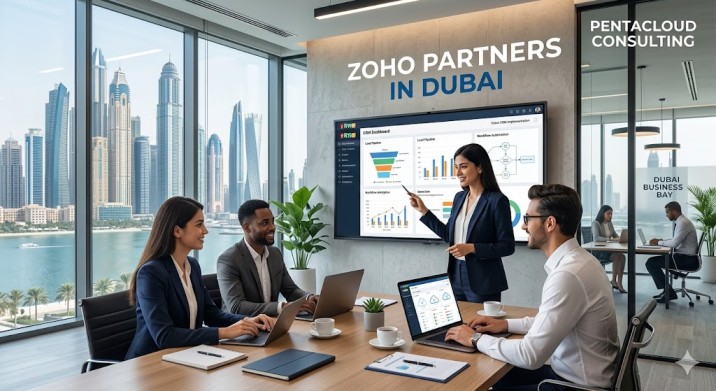
Zoho partners in Dubai now play a major role in helping GCC businesses modernize customer management, automate operations, and improve business visibility across departments. Companies across the UAE, Saudi Arabia, and Qatar increasingly rely on CRM platforms to manage sales pipelines, customer engagement, approvals, and reporting more efficiently. Many organizations, however, struggle when generic CRM setups fail to match actual operational workflows.
The problem becomes more serious during regional expansion or digital transformation projects. Teams often manage customer data through disconnected spreadsheets, manual approvals, and fragmented communication systems. This slows decision-making and reduces operational efficiency across departments.
GCC enterprises are increasingly prioritizing scalable CRM systems that support multilingual operations, cloud accessibility, and integrated business workflows. Businesses now expect CRM platforms to improve operational performance instead of functioning only as customer databases.
This article explains how Zoho partners in Dubai support GCC organizations, the regional challenges businesses face, how to evaluate implementation partners, and what successful Zoho deployment strategies look like across modern GCC enterprises.
Pentacloud Consulting has guided organizations across logistics, healthcare, retail, and professional services sectors through CRM modernization initiatives designed for GCC operational environments.
What Are Zoho Partners in Dubai? A GCC Business Definition
Zoho partners in Dubai help GCC businesses implement, customize, integrate, and optimize Zoho applications for regional business operations. These partners support CRM deployment, workflow automation, reporting, cloud integration, and operational scalability while aligning systems with GCC-specific requirements such as multilingual communication, regional governance, and business process efficiency. Organizations across the UAE, Qatar, and Saudi Arabia often work with Dubai-based Zoho experts because they combine enterprise-level technical capabilities with strong understanding of GCC business operations.
Zoho implementation requires more than basic software configuration. Businesses need workflows that reflect real operational structures, reporting needs, and customer engagement processes.
A strong Zoho partner helps organizations redesign workflows before deployment begins. This approach improves adoption and reduces operational inefficiencies later.
Zoho partners also help connect customer service, finance, operations, and sales into one centralized ecosystem. Businesses gain better visibility and faster decision-making across regional operations.
Why Zoho Implementation Is More Complex in GCC Markets
GCC organizations operate within business environments that require stronger localization and operational governance than standard CRM deployments.
One major challenge involves multilingual communication. Businesses across the GCC often manage both Arabic and English workflows across customer interactions, approvals, and reporting systems. CRM environments must support both languages without creating duplicate processes.
Legacy business systems create another challenge. Many GCC enterprises still rely on older ERP or accounting platforms that require customized integration planning. Zoho partners must carefully align these systems to maintain operational continuity.
Regional governance and compliance expectations also influence implementation planning. Businesses in healthcare, logistics, and government-related sectors often require structured permission management and stronger reporting visibility.
⚠️ Expert Warning: A common mistake GCC businesses make when selecting Zoho partners in Dubai is focusing only on CRM features instead of operational workflow alignment. This typically results in low employee adoption, inconsistent reporting, and expensive process redesign later.
Another challenge involves organizational change management. Employees accustomed to manual workflows often resist automation unless businesses include structured onboarding and workflow optimization strategies during implementation.
How to Evaluate Zoho Partners in Dubai
- Regional Business Knowledge: Assess whether the partner understands GCC business structures, multilingual workflows, and operational governance — experienced partners align CRM systems with regional operational realities.
- Integration Expertise: Evaluate the partner’s ability to integrate Zoho with ERP, finance, inventory, and third-party systems — strong integration planning improves operational efficiency across departments.
- Customization Capability: Review how the partner handles workflow automation, dashboard configuration, and process alignment — scalable customization supports long-term business growth.
- Industry Experience: Assess whether the partner has worked within your industry — logistics, healthcare, retail, and professional services each require different CRM structures.
- Training and Adoption Support: Strong onboarding programs improve employee adoption and reduce workflow resistance after deployment.
- Scalability Planning: Businesses should ensure the CRM architecture supports future regional expansion and operational complexity.
- Support and Optimization: Ongoing support helps organizations refine workflows and automation as operational requirements evolve.
In-House Zoho Deployment vs Zoho Partners in Dubai
| Factor | In-House Deployment | Zoho Partners in Dubai |
|---|---|---|
| Regional Workflow Knowledge | Limited internal exposure | Strong GCC operational familiarity |
| Deployment Speed | Slower due to resource limitations | Measurably faster deployment |
| Integration Capability | Depends on internal expertise | Better enterprise integration support |
| Employee Training | Limited onboarding resources | Structured adoption programs |
| Multilingual Workflow Support | Often requires external help | Better Arabic and English workflow planning |
| Scalability Planning | Focused on immediate needs | Designed for long-term growth |
| Reporting Structure | Can become fragmented | More centralized reporting visibility |
| Ongoing Optimization | Internal maintenance burden | Continuous support and workflow refinement |
In-house deployment can work for businesses with experienced internal CRM teams and simpler operational structures. Zoho partners in Dubai become more valuable when organizations require multi-country coordination, advanced integration, or scalable workflow automation.
The GCC tipping factor usually involves operational complexity. Businesses operating across several departments and regional offices benefit significantly from specialized implementation expertise.
How GCC Businesses Implement Zoho Successfully
Phase 1: Discovery and Workflow Assessment
Businesses begin by evaluating existing operational processes, reporting gaps, and customer management challenges. Stakeholders identify workflow inefficiencies and integration dependencies before implementation starts.
Phase 2: CRM Architecture Planning
Zoho consultants design workflows, automation logic, dashboards, and user roles aligned with operational requirements. This phase helps organizations avoid replicating inefficient legacy processes.
Phase 3: Customization and Integration
Teams configure workflows, automate tasks, and integrate Zoho with existing business platforms. Businesses operating across Dubai, Riyadh, and Doha often require centralized reporting visibility during this phase.
Phase 4: Testing and User Training
Departments validate workflows against real operational scenarios. Teams also receive role-specific training to improve adoption and reduce operational disruption after launch.
Phase 5: Go-Live and Optimization
Organizations transition into live CRM environments with support structures in place. Continuous optimization helps businesses refine automation and improve reporting accuracy over time.
Industry Scenario:
A retail company in the UAE struggled with disconnected customer records and inconsistent communication between online and in-store sales teams. The organization implemented a customized Zoho CRM environment that centralized customer data, automated follow-ups, and improved reporting visibility across regional operations. Teams achieved better coordination and improved customer engagement across multiple locations.
How Pentacloud Consulting Supports Zoho Projects in GCC Markets
Pentacloud Consulting applies a workflow-first CRM methodology designed for GCC operational environments. The company evaluates reporting structures, customer engagement processes, integration dependencies, and scalability requirements before configuring Zoho systems.
The approach combines Zoho CRM consulting, cloud integration services, and enterprise data migration capabilities into one structured delivery framework. This improves operational continuity and reduces deployment complexity.
Pentacloud Consulting supports businesses through regional offices in Dubai, India, and Qatar. Multilingual coordination, agile delivery models, and familiarity with GCC operational expectations help organizations implement CRM systems more effectively.
The company also focuses on sustainable CRM governance. Excessive customization without documentation can create future maintenance challenges. Pentacloud balances operational flexibility with long-term scalability and maintainability.
A major trend shaping 2025–2026 CRM strategies across the GCC involves AI-assisted workflow automation and predictive customer engagement reporting. Businesses increasingly expect CRM platforms to function as operational intelligence systems instead of standalone customer databases.
What’s Changing for Zoho CRM in GCC Markets Through 2026
Businesses across the GCC increasingly prioritize connected operational ecosystems instead of isolated CRM systems. Organizations now expect customer engagement, reporting, analytics, and workflow automation to function together seamlessly.
Saudi Vision 2030 and UAE AI Strategy 2031 continue encouraging enterprise modernization across regional markets. Businesses increasingly invest in scalable cloud-based systems that support agility and operational visibility.
Another major shift involves mobile workforce management. Companies increasingly require CRM environments optimized for remote access, field operations, and distributed teams.
Conclusion
Successful CRM transformation in GCC markets depends on much more than software deployment. Businesses achieve stronger outcomes when CRM workflows align with operational structures, reporting requirements, and long-term scalability strategies. Organizations that prioritize workflow planning early often experience better adoption and more efficient business operations.
Decision-makers now understand that selecting the right implementation partner directly affects operational visibility, customer engagement, and future business scalability.
Pentacloud Consulting helps GCC enterprises align Zoho CRM implementation with operational goals, regional workflows, and scalable digital transformation strategies.
Businesses planning CRM modernization initiatives across the GCC can explore Zoho partners in Dubai through Pentacloud Consulting.