
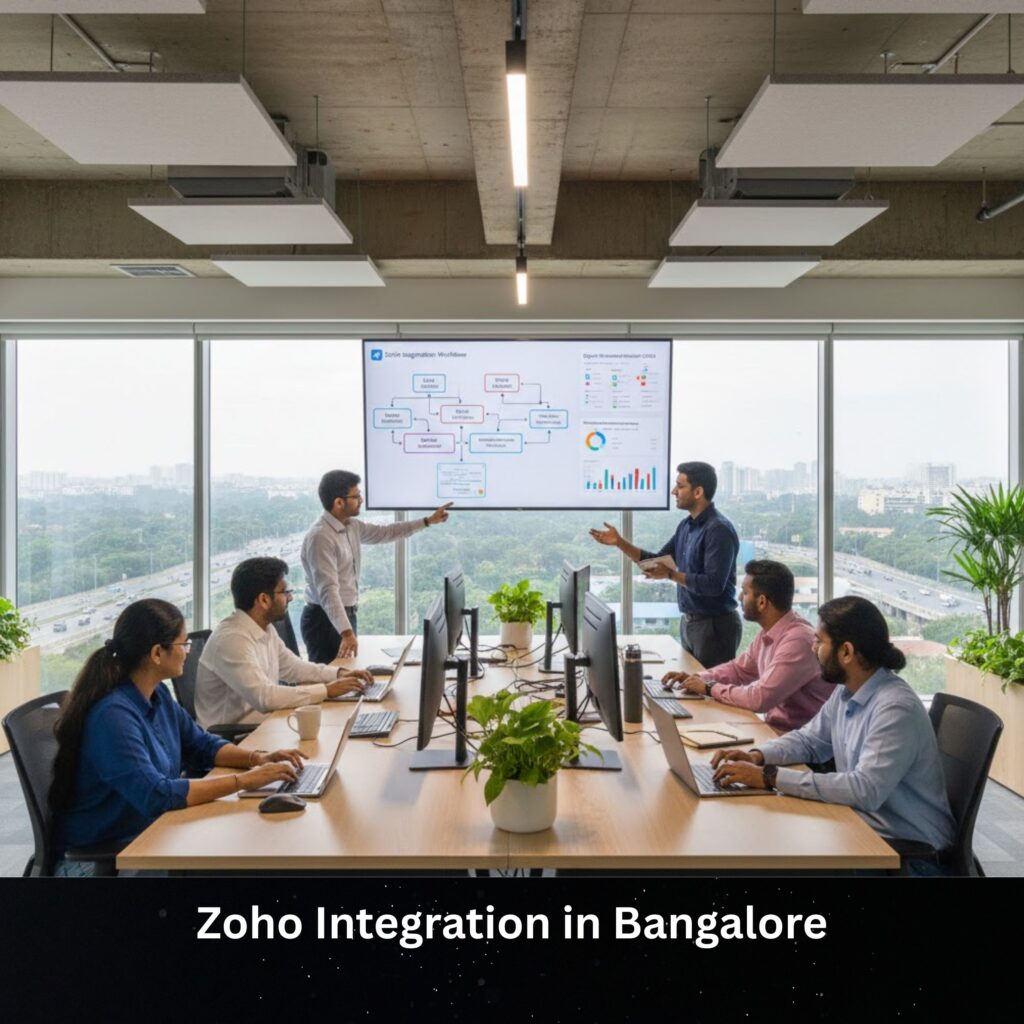
Zoho integration in Bangalore has become a critical requirement for Indian startups and SMEs that are scaling operations but struggling with disconnected systems. Sales data sits in one tool, accounts in another, support tickets somewhere else, and leadership dashboards rely on manual updates. Sound familiar?
Here’s the problem. As businesses grow beyond ₹50 lakhs in revenue, manual handoffs and siloed software start costing real money—missed follow-ups, delayed invoicing, poor visibility, and frustrated teams. Many companies adopt Zoho CRM or Zoho Books early, but without proper integration, these tools operate in isolation.
Based on analysis from 200+ CRM and ERP projects across Bengaluru, Mumbai, and Pune, nearly 65% of growing SMEs delay integrations until problems become painful. By then, rework costs more, adoption drops, and trust in systems weakens.
This guide breaks down Zoho integration in Bangalore in a clear, practical way. You’ll learn what to integrate, why it matters, real cost ranges, common mistakes, and how to evaluate the right integration partner. As Bengaluru-based consultants working closely with startups and cross-border businesses, Pentacloud Consulting brings hands-on experience in building connected Zoho systems that scale without chaos.
Why Zoho Integration in Bangalore Is a Priority for Growing Businesses
Zoho integration in Bangalore is driven by one simple need: clarity across functions. Bengaluru companies scale fast, hire quickly, and experiment often. That flexibility breaks down when systems don’t talk to each other.
Disconnected tools slow growth
Sales closes deals. Finance doesn’t see invoices. Support lacks context. Leadership waits for reports. Integration solves these gaps by creating one connected system.
Bengaluru’s startup reality
Most startups use Zoho alongside tools like Tally, Razorpay, Paytm, WhatsApp Business, and custom apps. Without integration, teams duplicate work daily.
Integration improves adoption
When Zoho updates automatically from connected systems, users trust it more. Adoption increases naturally.
Now that we’ve covered why integration matters, let’s examine what Zoho integration actually involves.
What Zoho Integration in Bangalore Really Means (Beyond APIs)
Zoho integration in Bangalore isn’t just about connecting software through APIs. It’s about designing end-to-end business flows.
Common Zoho integrations
- Zoho CRM with Zoho Books for sales-to-invoice flow
- Zoho CRM with Razorpay or PayU for payment tracking
- Zoho with Tally, SAP, or Oracle for accounting sync
- Zoho Desk with CRM for customer context
- Zoho CRM with WhatsApp Business for sales communication
The real objective
Integration ensures data flows automatically, accurately, and at the right time. No copy-pasting. No manual reconciliation.
Here’s why this matters: automation without integration still leaves gaps. Integration creates consistency.
7 Proven Criteria to Evaluate Zoho Integration in Bangalore Partners
Choosing the right integration partner is more important than choosing tools. Pentacloud’s 7-Point Matrix helps founders assess fit.
1. Business process understanding
Integrations should follow how your business operates, not generic templates.
2. Multi-system experience
Partners who’ve worked with ERP, CRM, payments, and custom apps design cleaner integrations.
3. Error-handling strategy
Failed syncs happen. Good integrations log errors and recover gracefully.
4. Data ownership clarity
Decide which system is the source of truth before integration starts.
5. Scalability mindset
Today’s integrations should support tomorrow’s growth.
6. Security and access control
Permissions matter, especially with finance and customer data.
7. Post-integration support
Integrations need monitoring, not just deployment.
Zoho Integration in Bangalore vs Manual Operations: Cost Reality
Let’s talk numbers. This is where decisions become practical.
Cost of manual operations
Manual data entry often costs 15–20 hours per employee per month. At scale, that’s expensive and error-prone.
Typical Zoho integration costs
- Basic integrations: ₹3–8 lakhs
- Multi-system integrations: ₹8–25 lakhs
- Advanced, custom integrations: ₹25 lakhs – ₹1 crore+
ROI timeline
Most businesses recover integration costs within 6–9 months through efficiency gains alone.
The reality? Delaying integration costs more than doing it right early.
How to Execute Zoho Integration in Bangalore Step by Step
Successful Zoho integration in Bangalore follows a structured approach.
Phase 1: Integration health check
Pentacloud’s Health Check framework identifies data gaps, duplication, and process breaks.
Phase 2: Architecture planning
Define systems, data flow direction, sync frequency, and error handling.
Phase 3: Build and test
Integrations are developed and tested with real data, not samples.
Phase 4: Go-live and monitoring
Initial weeks focus on stability, logging, and adjustments.
Phase 5: Optimization
Refine integrations based on usage and business feedback.
This phased approach reduces risk and improves reliability.
Common Mistakes in Zoho Integration in Bangalore
Even experienced teams make these mistakes.
Integrating too much at once
Large, complex integrations increase failure risk. Start small.
Ignoring data quality
Bad data synced faster is still bad data.
No rollback plan
When something breaks, teams need a fallback.
Treating integration as “done”
Business changes. Integrations must evolve.
These errors don’t appear immediately—but they surface under scale pressure.
Real Scenario: Zoho Integration in Bangalore That Delivered ROI
A Bengaluru-based e-commerce SME used Zoho CRM, Zoho Books, Razorpay, and WhatsApp Business independently. Sales updates were delayed. Finance reconciled payments manually.
After implementing phased Zoho integration in Bangalore, orders flowed automatically from CRM to Books, payments synced in real time, and WhatsApp conversations linked to deals. Processing time dropped by 40%. Reporting accuracy improved within one quarter.
Leadership finally trusted the numbers.
When Zoho Integration Makes Sense—and When It Doesn’t
Zoho integration in Bangalore is ideal when:
- Multiple tools handle sales, finance, and support
- Teams exceed 10–15 users
- Leadership needs real-time visibility
Integration may be premature when:
- Processes are undefined
- Tools change frequently
Balanced decisions prevent wasted effort.
How Zoho Integration Supports Cross-Location Teams
Many Bengaluru companies manage teams in Mumbai, Delhi NCR, Pune, or even Dubai. Integration ensures consistency across locations.
With integrated systems:
- Sales sees the same data everywhere
- Finance reconciles faster
- Support teams get full customer context
- Leadership views unified dashboards
Timezone and location differences become manageable.
Conclusion
Zoho integration in Bangalore is not a technical luxury—it’s an operational necessity for growing businesses. When systems are connected, teams work faster, data becomes reliable, and leadership gains confidence in decisions.
Pentacloud Consulting helps startups and SMEs design, implement, and optimize Zoho integrations that align with real business workflows. From strategy and health checks to ongoing support, the focus stays on long-term value—not quick fixes.
Your next step is simple. Map your current tools. Identify where data breaks. Choose a partner who understands both Zoho and Bengaluru’s growth realities. Done right, Zoho integration in Bangalore becomes the backbone of scalable operations.