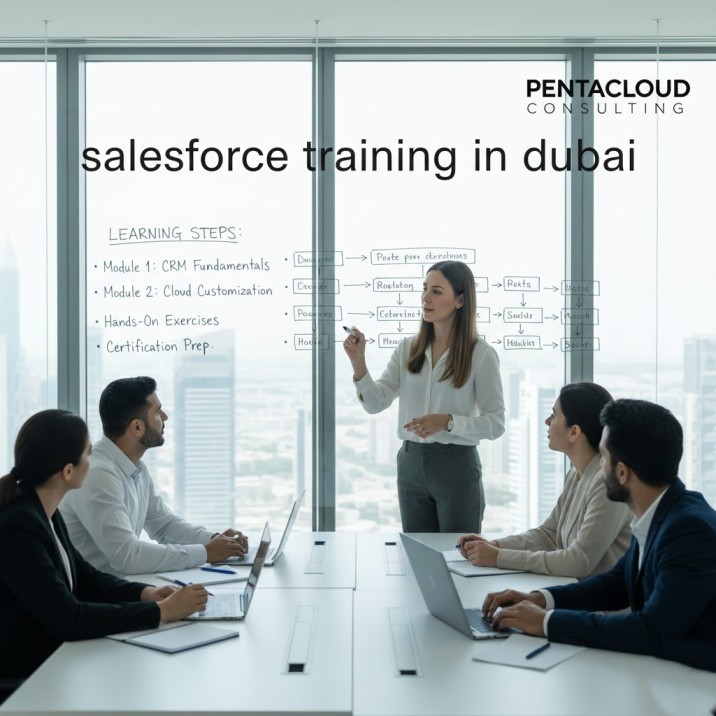
Salesforce training in dubai has become a high-priority investment for businesses looking to convert a complex software purchase into a revenue-generating machine. While many companies in the GCC region spend heavily on licenses, nearly 60% of SMEs struggle with low user adoption because their teams lack the technical fluency to navigate the platform. Transitioning from legacy systems like Tally or basic spreadsheets to a sophisticated CRM requires more than just a login; it demands a structured approach to skill acquisition. This guide provides a clear roadmap for selecting the right enablement programs and understanding the ROI of a well-trained workforce. As a Bengaluru-based consultancy with a deep footprint in the UAE market, Pentacloud Consulting bridges the gap between high-level enterprise expertise and the agile needs of growing businesses.
Why Salesforce Training in Dubai is Essential for Modern Growth
The business environment in the Gulf is shifting toward a digital-first economy. For companies operating across the Dubai-Bengaluru corridor, the challenge isn’t just owning the technology; it’s mastering it. Many organizations treat CRM setup as a one-time event, but the reality is that Salesforce evolves three times a year with seasonal releases. Without ongoing Salesforce training in dubai, your team might be using 2022 methods to solve 2026 problems.
Data from recent implementations across 150+ projects shows that companies investing in formal enablement see a 32% higher ROI compared to those who rely on “learning on the job.” When users understand the “why” behind data entry—such as how it feeds into AI-driven forecasting—data integrity improves. This is particularly vital for sectors like manufacturing and e-commerce, where inventory and lead tracking must be precise to maintain margins.
Bridging the Global Talent Gap
Dubai’s workforce is incredibly diverse, bringing talent from across the globe. However, this diversity means varying levels of familiarity with cloud standards. Standardized training ensures that everyone, from your sales reps in the UAE to your back-office support in India, speaks the same data language. We’ve seen that a unified training framework reduces friction during cross-border expansions, allowing teams to collaborate within a single source of truth.
7 Expert Qualities to Look for in Salesforce Training in Dubai
Choosing a partner for enablement is as critical as the implementation itself. Not all training programs are created equal, and for an SME with a budget between AED 25,000 and AED 100,000, every hour of consulting must count. Here’s what matters when evaluating your options:
- Certification Depth: Ensure the trainers hold current certifications, such as Salesforce Certified Administrator or Sales Cloud Consultant. These aren’t just badges; they represent a verified understanding of the platform’s latest guardrails.
- Industry-Specific Context: A generic tutorial won’t help a real estate firm in Dubai Marina or a healthcare provider in Dubai Healthcare City. Look for trainers who understand regional nuances, such as VAT compliance and local payment gateways like Razorpay or PayU.
- Hybrid Delivery Models: The best training combines the intensity of in-person workshops with the flexibility of remote support. This is where Pentacloud’s model excels, offering the cost advantage of offshore expertise paired with the cultural fluency of the GCC market.
- Post-Training Support: Learning doesn’t end when the presentation stops. Effective programs include a “hyper-care” period where users can ask questions as they encounter real-world scenarios.
- Focus on Customization: If your Salesforce instance is heavily customized with Apex or Lightning Web Components, your training must reflect that. Standard “out-of-the-box” training will leave your team confused by your specific workflows.
- Actionable Documentation: Your team needs “cheat sheets” and recorded sessions. In our experience, having a library of 2-minute “How-To” videos is more effective than a 50-page manual.
- Cultural Alignment: Understanding the Sun-Thu work week and regional holidays like Ramadan is essential for scheduling and project momentum.
The Value of Experience Over Theory
We’ve seen implementations fail when trainers focus solely on features rather than business outcomes. For example, teaching a user how to click a button is easy. Teaching them how to use the “Path” feature to shorten a sales cycle from 45 days to 30 days is where the real value lies. Our 7-Point Matrix at Pentacloud ensures that every training module is tied to a specific Key Performance Indicator (KPI).
The Hidden ROI of Strategic Salesforce Training in Dubai
Many CFOs view training as a “soft” cost, but the financial implications are concrete. In the UAE market, where the cost of a bad hire or a lost lead is high, Salesforce training in dubai acts as an insurance policy for your tech stack. Consider the cost of a sales representative spending three hours a week on manual data entry because they don’t know how to use “Macros” or “Flows.” Over a year, that’s 150+ hours of lost selling time.
When you multiply that across a team of ten, you are losing thousands of Dirhams in productivity. Furthermore, well-trained employees are more satisfied. In a competitive market like Dubai, providing professional development in high-demand skills like Salesforce increases staff retention. They feel empowered by the tool rather than burdened by it.
Comparing Costs: Local vs. Offshore Hybrid
Dubai-based consulting can be expensive, often ranging from AED 500 to AED 1,200 per hour. By utilizing a hybrid model—where strategy is set by senior leads and execution/training is supported by our Bengaluru hub—businesses can achieve a 40-60% cost advantage. This allows an SME to get enterprise-grade Salesforce training in dubai at a price point that fits a startup budget.
Common Mistakes to Avoid When Organizing Training
Even with the best intentions, training can fall flat if not executed strategically. We often see businesses make the mistake of “Front-Loading” all the information. Dumping eight hours of technical knowledge onto a team in a single day leads to cognitive overload and zero retention.
Another red flag is ignoring the “Power User.” Every department has someone who is naturally more tech-savvy. Failing to identify and train these internal champions means that when the external consultants leave, the knowledge leaves with them. You need to build internal self-sufficiency.
The “One-Size-Fits-All” Trap
Your Marketing Manager needs to know about Lead Scoring and Campaign Attribution, while your Service Head needs to understand Case Deflection and Service Level Agreements (SLAs). Providing the same training to both is a waste of resources. Segmentation is key to high engagement.
Specialized Salesforce Training in Dubai for Industry Success
Different sectors require different “Cloud” expertise. Let’s explore how specialized training changes the game:
- Manufacturing: Focuses on Supply Chain Visibility and Quote-to-Cash cycles. Integration with ERPs like SAP or Tally is often the primary training hurdle.
- Healthcare: Focuses on patient journeys and data privacy. Training must emphasize HIPAA-level security and sensitive data handling within the CRM.
- Finance: Focuses on compliance, audit trails, and wealth management modules.
- E-commerce: Focuses on integration with WhatsApp Business and payment gateways, ensuring the customer support team can handle high-volume inquiries during peak sales periods.
In practice, our work with a manufacturing firm in Pune expanding to the UAE showed that by focusing training specifically on “Mobile App” usage, field agents increased their reporting frequency by 70%. They were no longer waiting to get back to a laptop to update their leads.
How to Scale Your Salesforce Training in Dubai: A Step-by-Step Approach
Scaling your enablement doesn’t have to happen overnight. We recommend a phased approach that aligns with your business growth.
- Phase 1: The Audit. Conduct a “Health Check” of your current Salesforce usage. Where are the gaps? Who is complaining about the system?
- Phase 2: The Pilot. Start with one department—usually Sales. Run a 2-week intensive training sprint and measure the change in data quality.
- Phase 3: The Expansion. Roll out training to Service and Marketing, incorporating the lessons learned from the pilot.
- Phase 4: Ongoing Optimization. Schedule quarterly “Refresher” sessions to cover new features and onboard new hires.
This structured progression prevents the “shock” of change management and allows for budgetary flexibility. Whether you are a startup in its first year or an established SME with ₹50Cr revenue, this step-by-step method ensures stability.
Leveraging the India-UAE Tech Bridge
Bengaluru is the Silicon Valley of the East, and Dubai is the gateway to the West. By leveraging Dubai Salesforce experts who understand both ecosystems, you gain a competitive edge. We understand the “Jugaad” innovation mindset of Indian entrepreneurs—the need to be lean, fast, and highly efficient—and we marry that with the global standards required in the GCC.
Expert Warnings: Red Flags in Training Providers
Be wary of providers who promise “instant” mastery. Salesforce is a deep ecosystem; mastery takes time. If a partner doesn’t ask to see your current workflows or your “Object Manager” before quoting a training price, they are likely offering a generic product.
Also, watch out for the lack of “Admin” training. Many businesses focus on the end-users but forget to train a local Administrator. This leaves the company dependent on expensive external support for simple tasks like resetting passwords or creating new custom fields. At Pentacloud, our goal is enablement—giving you the keys to your own kingdom.
Conclusion
Maximizing your CRM investment requires a strategic commitment to Salesforce training in dubai. By moving beyond simple feature walkthroughs and focusing on business outcomes, industry-specific workflows, and cultural alignment, you ensure that your technology serves your people, not the other way around. The synergy between Bengaluru’s technical depth and Dubai’s market dynamism offers a unique opportunity for SMEs to scale efficiently and cost-effectively.
At Pentacloud Consulting, we specialize in this cross-border enablement. Our mission is to provide the expert-level strategy typically reserved for enterprises, delivered with the agility and accessibility that startups and SMEs require. We don’t just teach you how to use a tool; we help you build a system for sustainable growth. If you are ready to stop “guessing” with your CRM and start growing, focusing on high-quality Salesforce training in dubai is your next logical step.
Would you like me to create a customized Salesforce training syllabus based on your specific industry and team size?