
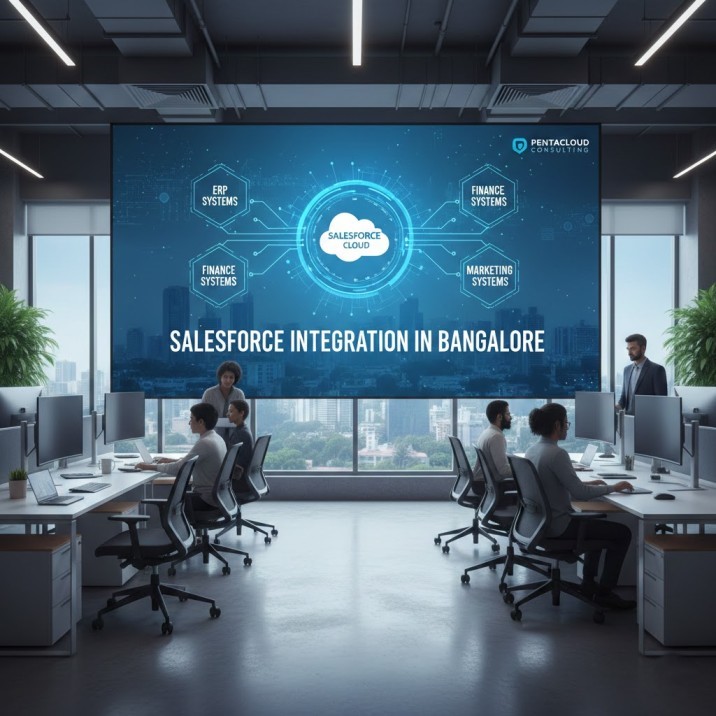
Salesforce integration in Bangalore has become a decisive growth factor for Indian startups and SMEs aiming to streamline sales, service, and operations. If your business generates between ₹50L and ₹50Cr, chances are you’re juggling Tally, Razorpay, WhatsApp Business, and spreadsheets alongside Salesforce. That patchwork slows you down.
We understand the frustration. You invested in Salesforce, but your ERP doesn’t sync. Finance pulls reports manually. Sales teams rely on WhatsApp more than CRM. Sound familiar?
Based on 200+ CRM transformations across Bengaluru, Mumbai, Pune, and Delhi NCR, we’ve seen one pattern clearly: Salesforce integration in Bangalore fails not because of technology—but because of poor planning and partner misalignment.
This guide gives you a structured evaluation framework. You’ll learn what separates average integrators from true transformation partners. As a Bengaluru-based consultancy bridging enterprise-grade execution with startup accessibility, Pentacloud Consulting has seen integrations succeed—and collapse. Let’s explore what actually drives success.
Why Salesforce Integration in Bangalore Is a Strategic Decision
Salesforce integration in Bangalore isn’t just a technical task. It’s a business systems redesign.
Bangalore is India’s tech capital. Startups scale quickly. SMEs modernize aggressively. But growth often creates disconnected systems—Tally for accounting, SAP for ERP, Zoho Books for finance, Razorpay for payments, and WhatsApp Business for communication.
Without structured Salesforce integration in Bangalore, you’ll face:
- Duplicate data
- Inconsistent reporting
- Manual reconciliation
- Slow decision cycles
The Complexity Behind “Simple” Integrations
Many founders assume integration means connecting APIs. In practice, it involves process mapping, data standardization, validation rules, and governance frameworks.
We worked with a Hyderabad SaaS company that attempted DIY Salesforce integration in Bangalore. Their payment data synced—but GST fields mismatched. Finance rejected CRM reports.
Lesson? Integration requires domain knowledge, not just technical skill.
Understanding this complexity sets the foundation for smart partner selection.
7 Essential Qualities in Salesforce Integration in Bangalore
Not all service providers approach Salesforce integration in Bangalore with the same depth. Here’s what truly matters.
1. Deep Process Discovery Before Development
If a partner skips discovery workshops, that’s a red flag.
Strong Salesforce integration in Bangalore begins with stakeholder interviews, data audits, and workflow mapping. Without clarity, automation amplifies chaos.
2. Expertise Across Indian Tech Stack
Your CRM likely connects to:
- Tally or SAP
- Razorpay or Paytm
- Zoho Books or QuickBooks
- Custom ERP modules
Experienced teams understand Indian GST structures and compliance implications during Salesforce integration in Bangalore.
3. Middleware and API Architecture Experience
Integration isn’t always point-to-point. Middleware tools improve scalability.
Ask about event-driven architecture, bulk APIs, and error-handling strategies. These separate seasoned integrators from basic developers.
4. Governance Framework
We use Pentacloud’s Health Check framework to define data ownership and automation boundaries before integration begins.
Without governance, Salesforce integration in Bangalore leads to broken flows within months.
5. Training and Adoption Planning
Integration is pointless if users ignore the system.
In practice, we’ve seen adoption jump significantly when structured enablement accompanies Salesforce integration in Bangalore.
6. Cross-Border Readiness
Many Bangalore startups expand into the GCC. That’s where alignment with Salesforce implementation Dubai and Dubai cloud consulting standards becomes important.
A partner experienced in GCC Salesforce services ensures future-proof architecture.
7. Post-Go-Live Optimization
The reality: Integration is phase one. Optimization is ongoing.
True Salesforce integration in Bangalore includes monitoring dashboards and periodic system reviews.
Salesforce Integration in Bangalore vs Basic CRM Customization
Understanding the difference prevents costly mistakes.
Customization changes Salesforce fields and workflows. Integration connects external systems.
When Integration Is Necessary
You need Salesforce integration in Bangalore if:
- Finance reports don’t match CRM
- Payments aren’t tracked automatically
- Inventory updates lag
- Sales reps double-enter data
Customization alone won’t solve these.
The Risk of Over-Automation
We’ve seen implementations fail when businesses automate everything at once.
Start focused. Prioritize high-impact flows. Expand later.
Now that we’ve covered the strategic difference, let’s examine real-world challenges.
Common Mistakes in Salesforce Integration in Bangalore
Mistakes are expensive. Here are the ones we encounter most.
Copying Enterprise Models Without Adaptation
A Pune manufacturer tried replicating an SAP-heavy architecture inside Salesforce. It created complexity no one used.
Salesforce integration in Bangalore must fit your operational maturity.
Ignoring Data Cleanliness
Garbage in, garbage out.
Before integration, conduct data audits. Remove duplicates. Standardize formats.
Choosing Price Over Expertise
This fear is justified—you want efficiency. But integration errors cost more long-term.
Balanced evaluation matters.
Technical Considerations for 2025 Salesforce Integration in Bangalore
Here’s what’s shaping decisions right now.
Hyperforce and Data Hosting
Salesforce Hyperforce supports scalable infrastructure. Businesses expanding toward Dubai cloud consulting projects should align architecture early.
AI and Predictive Insights
Einstein AI requires structured datasets. Poor integration weakens AI outcomes.
In our work with startups across Bengaluru and Mumbai, structured Salesforce integration in Bangalore improved forecasting reliability significantly.
Multi-Org vs Single-Org Strategy
Expanding into Dubai? Aligning Salesforce integration in Bangalore with Salesforce implementation Dubai reduces duplication.
Dubai Salesforce experts often restructure systems later if integration planning is weak.
Step-by-Step Evaluation Framework for Salesforce Integration in Bangalore
Here’s a practical path you can follow.
Step 1: Define Business Outcomes
Are you reducing reconciliation time? Improving sales visibility? Supporting GCC expansion?
Clarity drives integration design.
Step 2: Map Current Systems
Document ERP, accounting, payment, and communication tools. Include GST workflows.
This prevents surprises during Salesforce integration in Bangalore.
Step 3: Evaluate Technical Depth
Ask about API limits, middleware options, and bulk data migration strategies.
Experienced Salesforce integrators UAE working cross-border often bring advanced architecture knowledge.
Step 4: Assess Governance Plan
Who owns system changes? Who validates data?
Integration without governance collapses.
Step 5: Review Support and Scalability
Does the partner offer health checks? Admin certification prep? Ongoing enablement?
Long-term support sustains Salesforce integration in Bangalore success.
Real Scenario: Startup Scaling from Bengaluru to GCC
A fintech startup from Bengaluru approached us during rapid growth. They used Salesforce for sales, Tally for accounting, and Razorpay for collections.
Manual reconciliation delayed reports. Leadership lacked pipeline clarity.
Through structured Salesforce integration in Bangalore, we automated payment syncing, standardized GST fields, and aligned reporting dashboards.
Initially, we assumed API syncing would solve everything. After 150+ projects, we’ve learned integration must follow process redesign—not precede it.
Later, when the company explored Dubai expansion, the same architecture aligned smoothly with GCC Salesforce services. That foresight mattered.
Would a generic integrator have anticipated that? Unlikely.
Conclusion
Salesforce integration in Bangalore is more than connecting systems. It’s building a foundation for scalable, compliant, and insight-driven growth. For Indian startups and SMEs, the right partner combines technical expertise with business understanding.
You need structured discovery. Governance clarity. Adoption planning. And cross-border readiness if GCC expansion is on your roadmap.
Pentacloud Consulting, based in Bengaluru, bridges enterprise expertise with startup agility. From strategy and health checks to implementation and enablement, we help businesses design Salesforce integration in Bangalore that lasts.
If you’re evaluating partners, start with clarity. Define outcomes. Demand depth. Choose alignment over shortcuts.
Because the right Salesforce integration in Bangalore doesn’t just sync systems—it accelerates your next stage of growth.