Zoho customization services in Bangalore now play a central role in how GCC enterprises modernize operations across the UAE, Saudi Arabia, and Qatar. Many organizations face a critical challenge: their CRM platform exists, but workflows remain disconnected, approvals move slowly, and regional compliance requirements create operational friction. Leaders often discover these gaps during expansion, mergers, or digital transformation initiatives tied to Vision 2030 programs.
The problem escalates when teams rely on generic CRM setups that ignore multilingual operations, localized taxation structures, or cross-border approval chains. Sales, finance, and customer service departments start operating in silos. Reporting loses accuracy, and leadership struggles to gain a unified operational view across GCC offices.
Across the UAE and Saudi Arabia, mid-market firms and enterprise groups are increasingly prioritizing CRM customization over standard deployments. GCC organizations want platforms that reflect regional business logic instead of forcing teams to adapt to rigid workflows.
This article covers GCC-specific Zoho customization challenges, evaluation frameworks, implementation phases, and deployment considerations so that decision-makers can plan a stronger CRM strategy with lower operational risk.
Pentacloud Consulting has guided GCC enterprises through CRM modernization projects across logistics, healthcare, retail, and professional services environments.
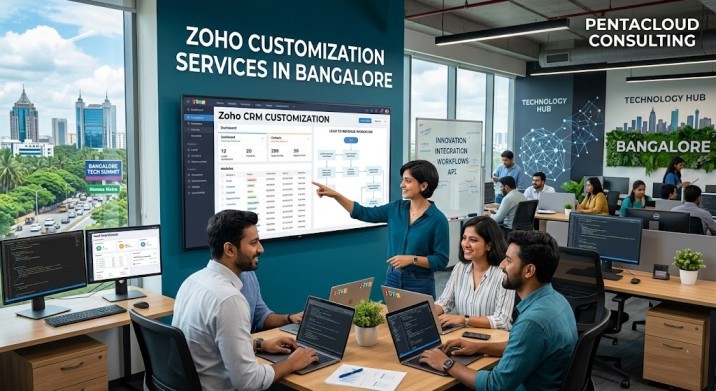
Zoho customization services in Bangalore help GCC businesses adapt Zoho CRM and related applications to match regional workflows, multilingual operations, regulatory requirements, and enterprise integration needs. These services typically include workflow automation, API integration, role-based access structures, reporting customization, Arabic interface alignment, and ERP connectivity. GCC organizations often choose Bangalore-based customization teams because they combine enterprise technical expertise with significantly more cost-effective delivery models and faster implementation support for UAE, Qatar, and Saudi Arabia operations.
Standard CRM deployments rarely support the operational complexity of GCC organizations. Many companies require approval hierarchies aligned with regional business structures, localized invoicing workflows, and integrations with finance or ERP systems already in place.
Customization also improves user adoption. Employees work faster when the CRM reflects their actual business process instead of generic templates. For GCC enterprises, this often includes Arabic-enabled workflows, mobile accessibility for distributed teams, and multi-country reporting visibility.
Pentacloud Consulting approaches Zoho customization with a process-first methodology that aligns CRM architecture with operational goals instead of simply modifying fields and dashboards.
GCC enterprises operate in environments that require stronger localization, compliance alignment, and cross-border coordination than many global CRM deployments.
One major challenge involves multilingual business operations. Many GCC organizations operate in both English and Arabic environments. CRM workflows, notifications, and approval structures must support bilingual communication without creating duplicate processes.
Another challenge comes from legacy ERP ecosystems. Large GCC firms frequently use older finance or inventory systems that lack modern API flexibility. Zoho customization teams must build middleware strategies or phased integrations to prevent operational disruption.
Data residency and compliance also influence deployment decisions. Organizations in sectors such as healthcare, government contracting, and logistics often require strict access control frameworks and region-aware hosting considerations.
⚠️ Expert Warning: A common mistake GCC enterprises make when customizing Zoho CRM is replicating outdated manual processes inside the CRM instead of redesigning workflows first. This typically results in low adoption, fragmented reporting, and expensive rework during expansion phases.
Saudization and Emiratization policies add another operational layer. Many enterprises require role-based workflow structures that reflect localized HR and operational governance models.
Trade-offs also exist. Highly customized CRM environments can reduce flexibility during future upgrades if organizations fail to document integrations and workflow logic properly
- Regional Workflow Understanding: Assess whether the provider understands GCC approval chains, procurement structures, and compliance expectations — strong providers map workflows around regional operational realities instead of generic CRM templates.
- Integration Capability: Evaluate API development expertise and middleware experience — effective GCC implementations often require integration with ERP, finance, HR, and logistics platforms already used across multiple regional offices.
- Arabic Localization Support: Review the team’s experience with bilingual workflows and interface adaptation — successful GCC deployments support Arabic communication without creating duplicate operational structures.
- Scalability Architecture: Determine whether the customization can support future expansion into Saudi Arabia, Qatar, or additional GCC markets — scalable CRM structures reduce migration risks later.
- Governance and Security Controls: Assess role-based permissions, audit visibility, and data handling processes — enterprise GCC environments require stronger operational governance than basic CRM setups.
- Implementation Methodology: Look for structured deployment frameworks such as Agile CRM delivery or ITIL-aligned governance — mature methodologies reduce operational disruption during rollout.
- Post-Deployment Support: Review optimization, training, and change-management capabilities — GCC teams often require continuous adoption support across distributed offices and multilingual teams.
<h2 id=”comparison”>In-House Zoho Customization vs GCC-Focused Consulting Partner</h2>
| Factor | In-House Customization | GCC-Focused Consulting Partner |
|---|---|---|
| Regional Compliance Knowledge | Often limited to internal processes | Better alignment with GCC operational regulations |
| Deployment Speed | Slower due to competing priorities | Measurably faster deployment through dedicated teams |
| Integration Expertise | Depends on internal developer skills | Stronger enterprise integration experience |
| Arabic Workflow Support | May require external specialists | Usually included in regional delivery models |
| Scalability Planning | Focused on immediate needs | Structured for multi-country GCC expansion |
| Change Management | Limited internal training bandwidth | Includes adoption and process alignment support |
| Long-Term Maintenance | Internal dependency risk | Shared governance and support continuity |
| Cost Structure | Higher internal resource overhead | Higher overall value for enterprise-scale rollouts |
In-house customization works well for smaller organizations with stable operational requirements and experienced internal CRM teams. GCC-focused consulting partners become more effective when businesses operate across multiple countries, require ERP integration, or face complex compliance requirements.
The GCC tipping factor usually involves operational complexity. Once workflows span several countries or departments, specialized customization experience becomes significantly more valuable.
- Phase 1: Discovery & Requirements Mapping
Business stakeholders, department heads, and technical teams define operational pain points and workflow dependencies. GCC organizations typically include compliance, multilingual communication, and approval governance requirements during this stage. Teams also assess integration needs with finance, HR, or ERP systems. - Phase 2: Process Redesign & Architecture Planning
CRM specialists redesign workflows before development begins. This phase prevents organizations from embedding inefficient legacy processes into the new environment. GCC businesses often prioritize role-based access structures and regional reporting frameworks here. - Phase 3: Customization & Integration Development
Developers configure workflows, dashboards, automation rules, and external integrations. API alignment becomes critical for enterprises operating across Dubai, Doha, and Riyadh offices. Testing focuses heavily on operational continuity and reporting accuracy. - Phase 4: User Acceptance Testing & Localization Review
Business users validate workflows, notifications, mobile functionality, and Arabic support requirements. Organizations confirm whether operational approvals reflect actual business structures. Security permissions and audit visibility also undergo review during this stage. - Phase 5: Training, Rollout & Optimization
Teams receive role-specific onboarding aligned with their daily workflows. Adoption monitoring becomes essential during the first operational cycles. Continuous optimization helps organizations refine automation based on live business usage.
Industry Scenario:
A logistics firm in Dubai struggled with fragmented shipment approvals and delayed customer updates across UAE and Saudi Arabia operations. The organization customized Zoho CRM to integrate approval workflows, driver coordination, and multilingual customer notifications into one centralized platform. The result was stronger operational visibility, faster coordination between regional teams, and significantly better reporting consistency.
Pentacloud Consulting applies a workflow-first customization methodology focused on operational alignment before technical configuration begins. The company evaluates business dependencies, approval structures, reporting gaps, and integration requirements before building CRM logic.
The approach combines Zoho CRM consulting, cloud integration expertise, and enterprise data migration capabilities into one delivery framework. This helps GCC businesses reduce fragmentation during implementation.
Pentacloud’s GCC delivery model differs because regional business expectations vary significantly between sectors such as healthcare, logistics, retail, and government contracting. Teams across Dubai, India, and Qatar collaborate closely to support multilingual operations and faster response cycles.
The firm also emphasizes scalable CRM governance. Excessive customization without documentation creates future maintenance risks. Pentacloud structures deployments to maintain upgrade flexibility while still supporting regional operational requirements.
A key 2025–2026 trend is the rise of AI-assisted CRM workflows within GCC enterprises. Many organizations now prioritize predictive reporting, automated customer routing, and intelligent workflow orchestration instead of standalone CRM functionality.
GCC enterprises are shifting from basic CRM digitization toward operational intelligence platforms. Organizations increasingly expect CRM systems to connect finance, customer engagement, logistics, and analytics into unified ecosystems.
Saudi Vision 2030 and UAE AI Strategy 2031 continue driving enterprise modernization initiatives across the region. Businesses now prioritize automation, compliance visibility, and faster decision-making instead of isolated CRM adoption projects.
Another major shift involves hybrid deployment governance. GCC organizations increasingly want cloud flexibility combined with stronger regional control over workflows, permissions, and operational visibility. This trend will continue shaping Zoho customization priorities through 2026.
Conclusion
The strongest GCC CRM strategies no longer focus only on software deployment. They focus on operational alignment, integration governance, and scalable workflow design. Organizations that redesign business processes before customization typically achieve stronger adoption and more sustainable digital transformation outcomes.
Decision-makers now understand that CRM customization success depends as much on regional workflow expertise as technical development capability.
Pentacloud Consulting helps GCC enterprises align Zoho CRM customization with operational goals, compliance expectations, and scalable business growth.
Businesses planning digital transformation initiatives across the UAE, Saudi Arabia, or Qatar can explore tailored Zoho customization services in Bangalore through Pentacloud Consulting.